
Agent Ecosystem Governance
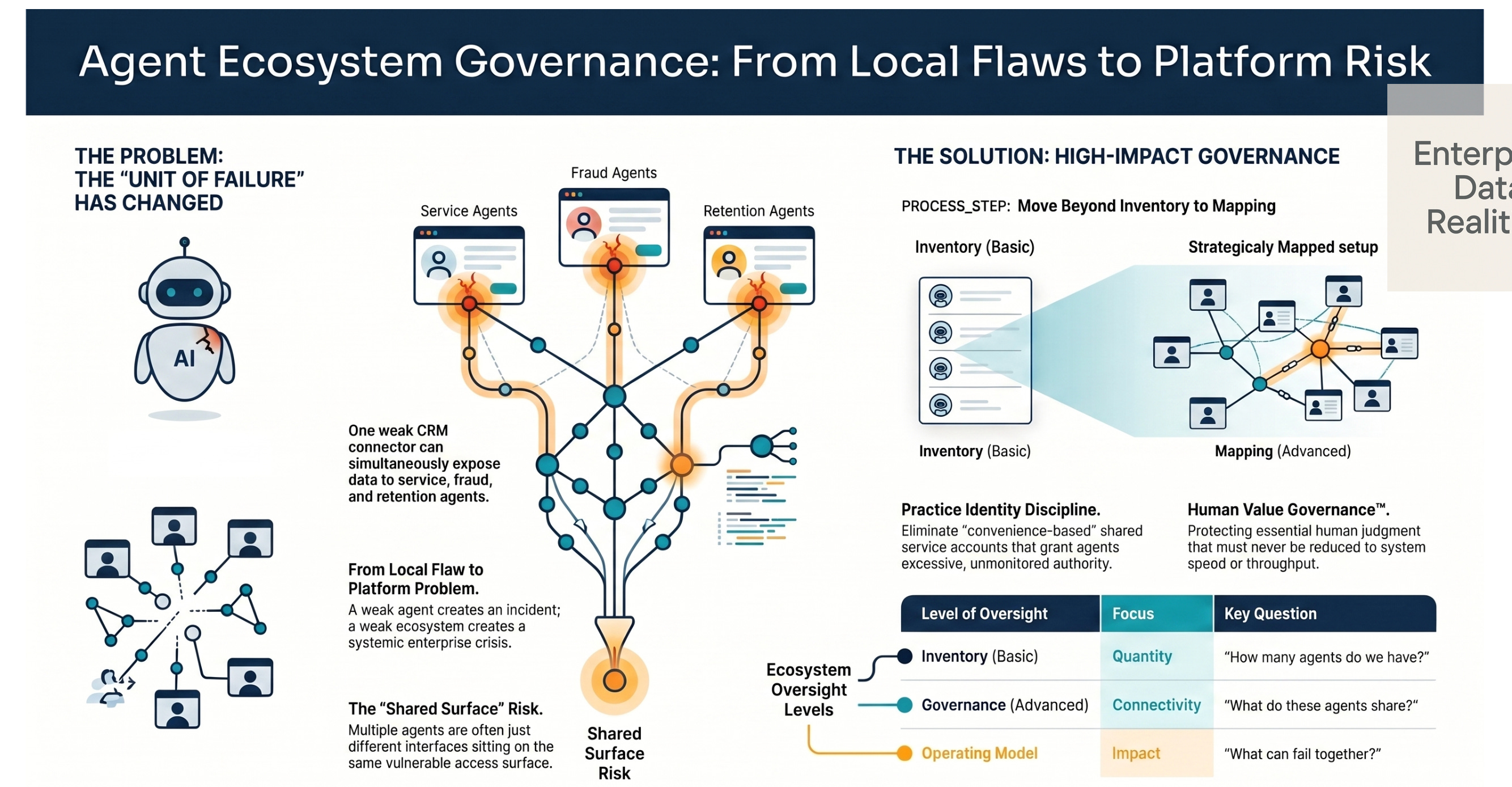
A weak agent is a risk. An agent ecosystem with weak governance is a control problem that spreads.

Pressed for time? Start with the summary.
One agent with broad access is bad design. Twenty agents built on the same weak defaults is not twenty separate risks. It is a platform problem.
Most organizations still assess agent risk one workflow at a time. One support assistant. One case summarizer. One internal research bot. One approval helper. That lens is already too narrow.
Large enterprises do not deploy one agent. They build an agent ecosystem.
Service agents, policy agents, fraud assistants, sales assistants, operations agents. Each one may look small on its own. Together, they often rely on the same connectors, the same identities, the same memory services, the same approval logic, and the same policy defaults.
That is where the real risk sits. The question is no longer what one agent can do. The question is how far one weak default can travel.
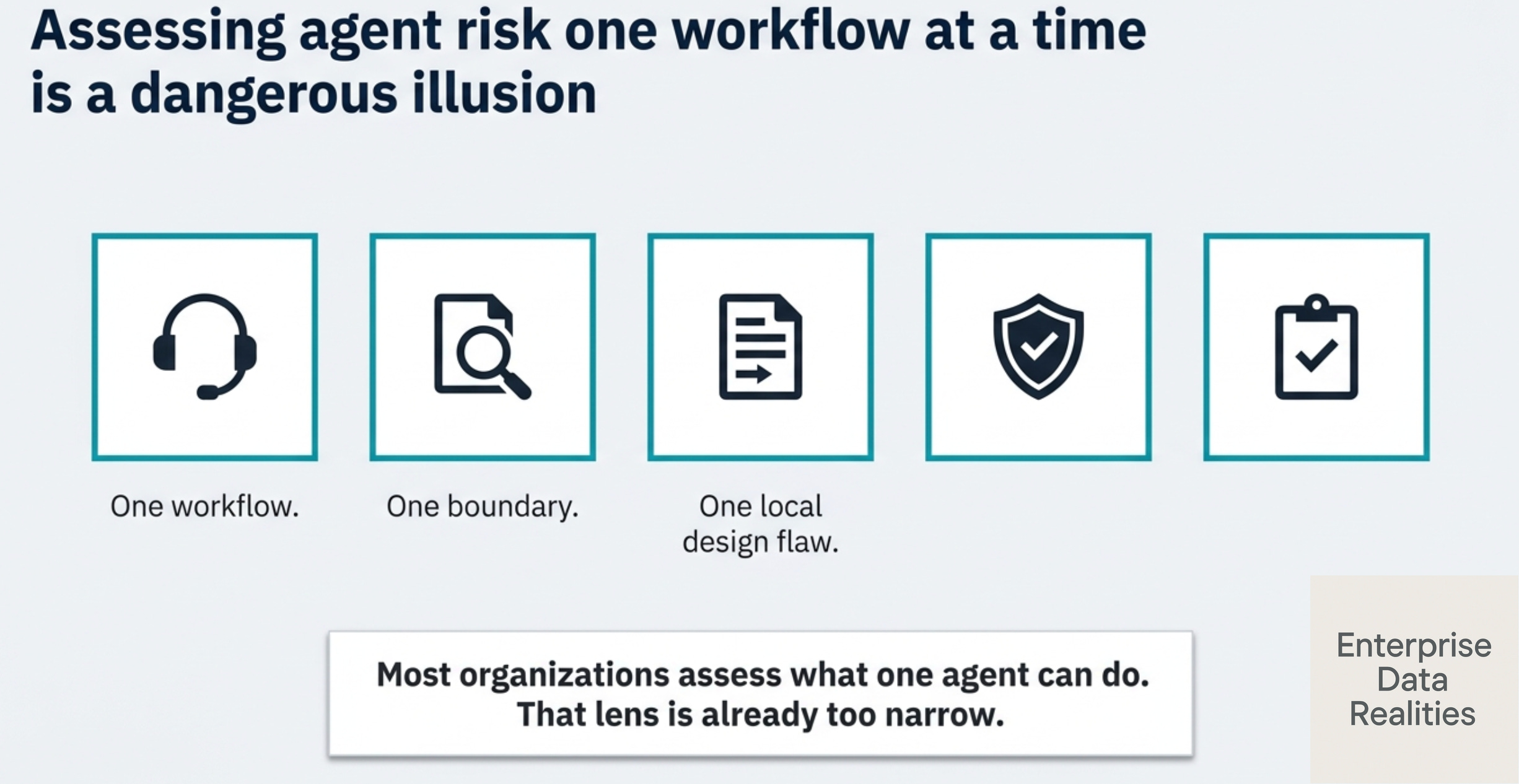
The unit of failure has changed
A weak agent can create one bad incident. An agent ecosystem can repeat the same bad design across support, fraud, servicing, collections, operations, and internal tooling at the same time.
The failure does not stay local.
A broad connector used by one agent is a concern. The same connector reused across twelve agents becomes a systemic weakness. A weak approval pattern in one business line is a problem. The same approval logic copied into every workflow becomes policy theater at scale.
This is why agent ecosystem governance matters. The issue is no longer isolated misbehavior. It is repeatable weakness. And that is how one control gap becomes a recurring operational cost.
Shared connectors turn local mistakes into enterprise risk
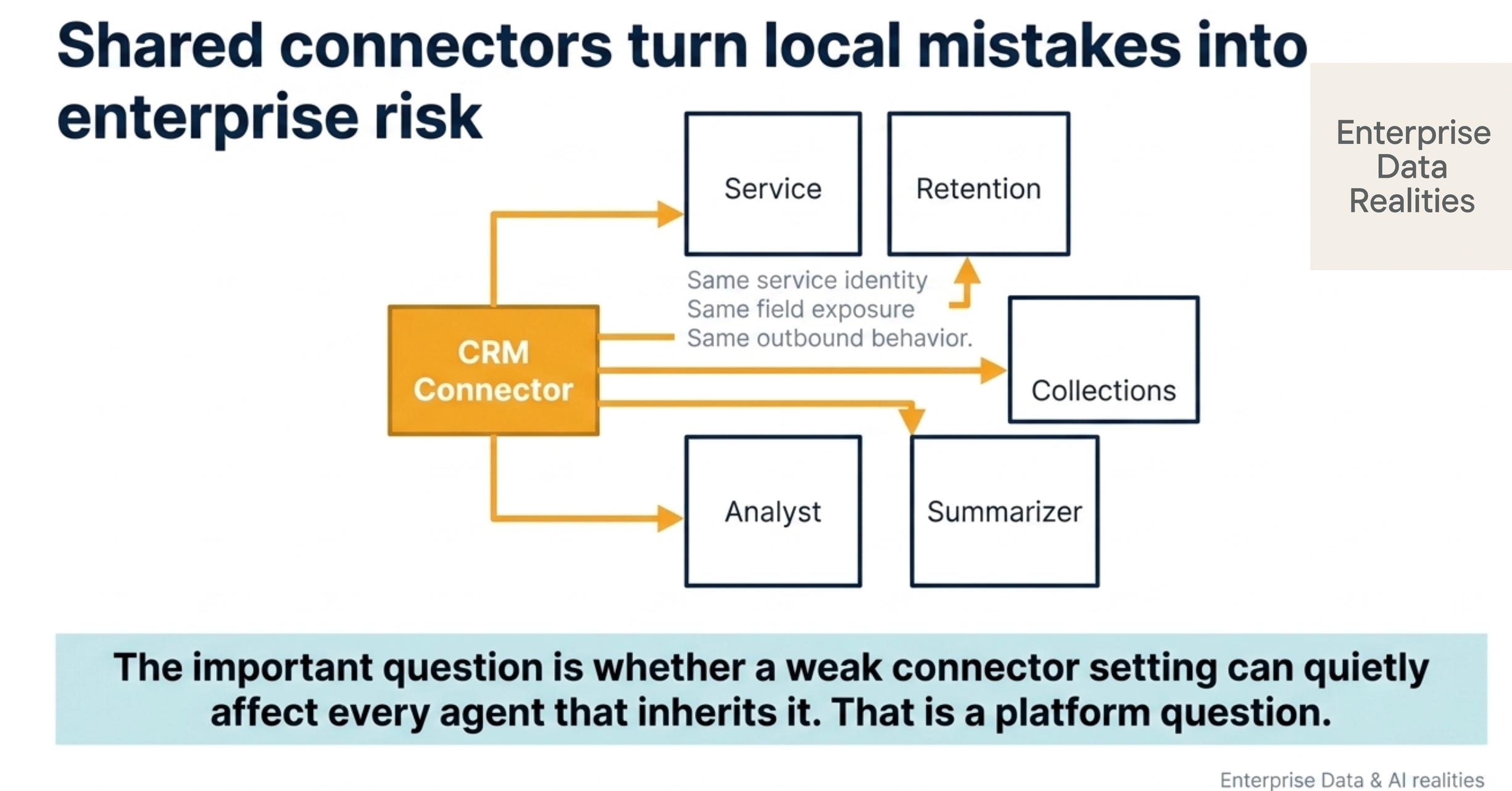
This is where the risk becomes concrete. One agent uses a CRM connector. Another uses the same one. Then a service agent, a retention assistant, and a complaint summarizer all inherit the same connector configuration, the same service identity, and the same field exposure.
Now one mistake does not move through one workflow. It moves across the enterprise.
Many organizations misread their own architecture. They think they deployed several distinct agents. In reality, they often deployed several different interfaces on top of the same access surface. That is not diversification. That is shared failure.
The important question is not whether a connector works for one agent. The important question is whether a weak connector setting can quietly affect every agent that inherits it. That is a platform question.
Shared policy defaults become silent platform policy
Central policy sounds reassuring until it starts to drift. One broad approval rule. One stale exception. One missing deny condition. That is often enough. Every agent that inherits that policy inherits the same weakness.
The problem is not whether a policy exists. The problem is whether the organization can answer basic operating questions:
Which agents are operating under which governance rules?
Which workflows still rely on outdated exceptions?
Which agents were reviewed under one control posture and now operate under another?
Without that visibility, policy becomes ambient. It is present everywhere and enforceable nowhere with precision. That is diffusion, not governance.
Shared memory spreads context errors faster
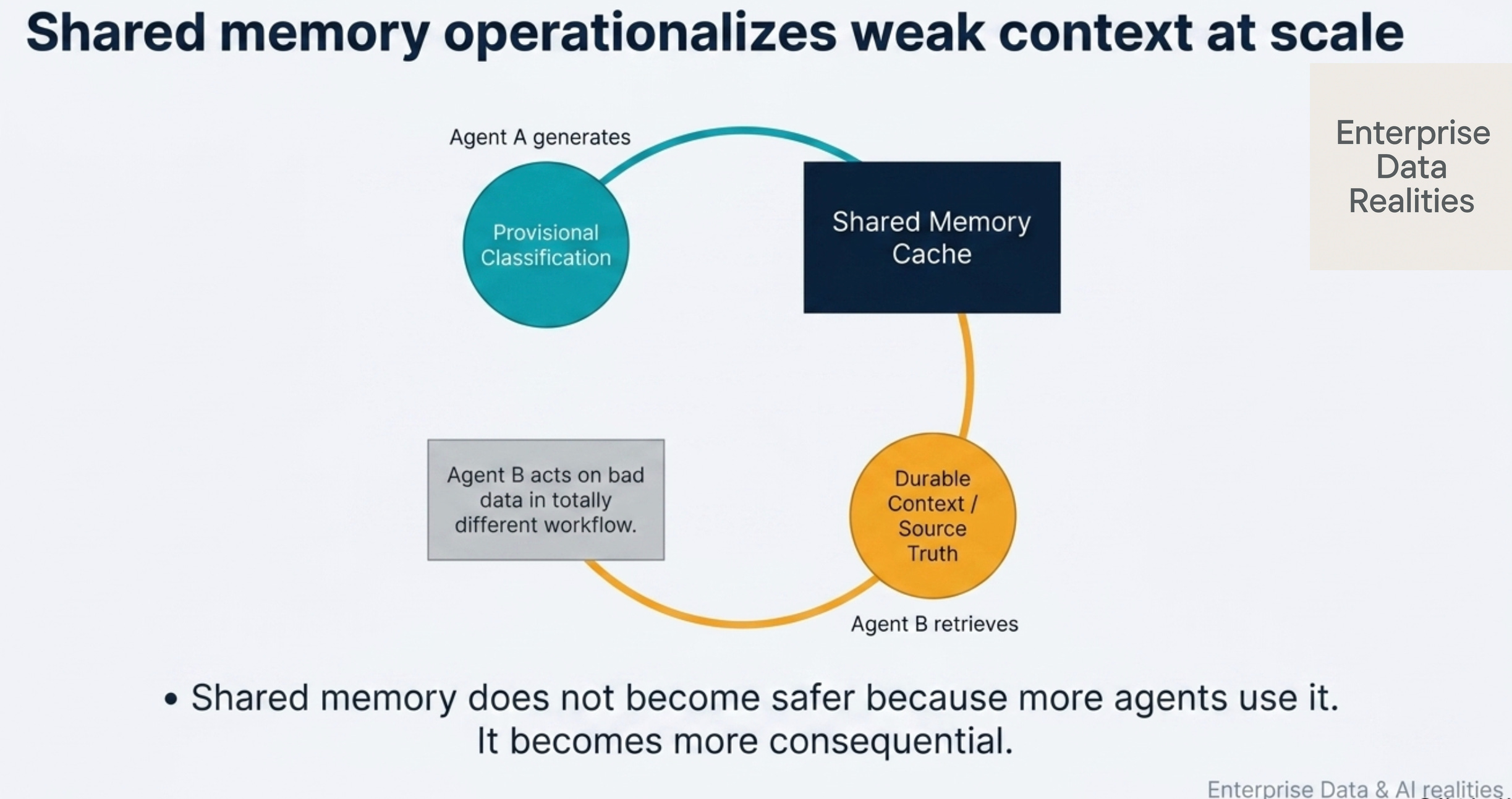
Shared memory sounds efficient. Sometimes it is just a faster way to distribute the same mistake. When multiple agents depend on the same memory service, the problem changes. It is no longer about one weak handoff. It becomes repeated context confusion across the broader system.
A stale note lives longer than it should. A derived summary gets treated as source truth. A provisional classification becomes durable context.
Now the system is not merely carrying weak context. It is operationalizing it over and over again. Shared memory does not become safer because more agents use it. It becomes more consequential.
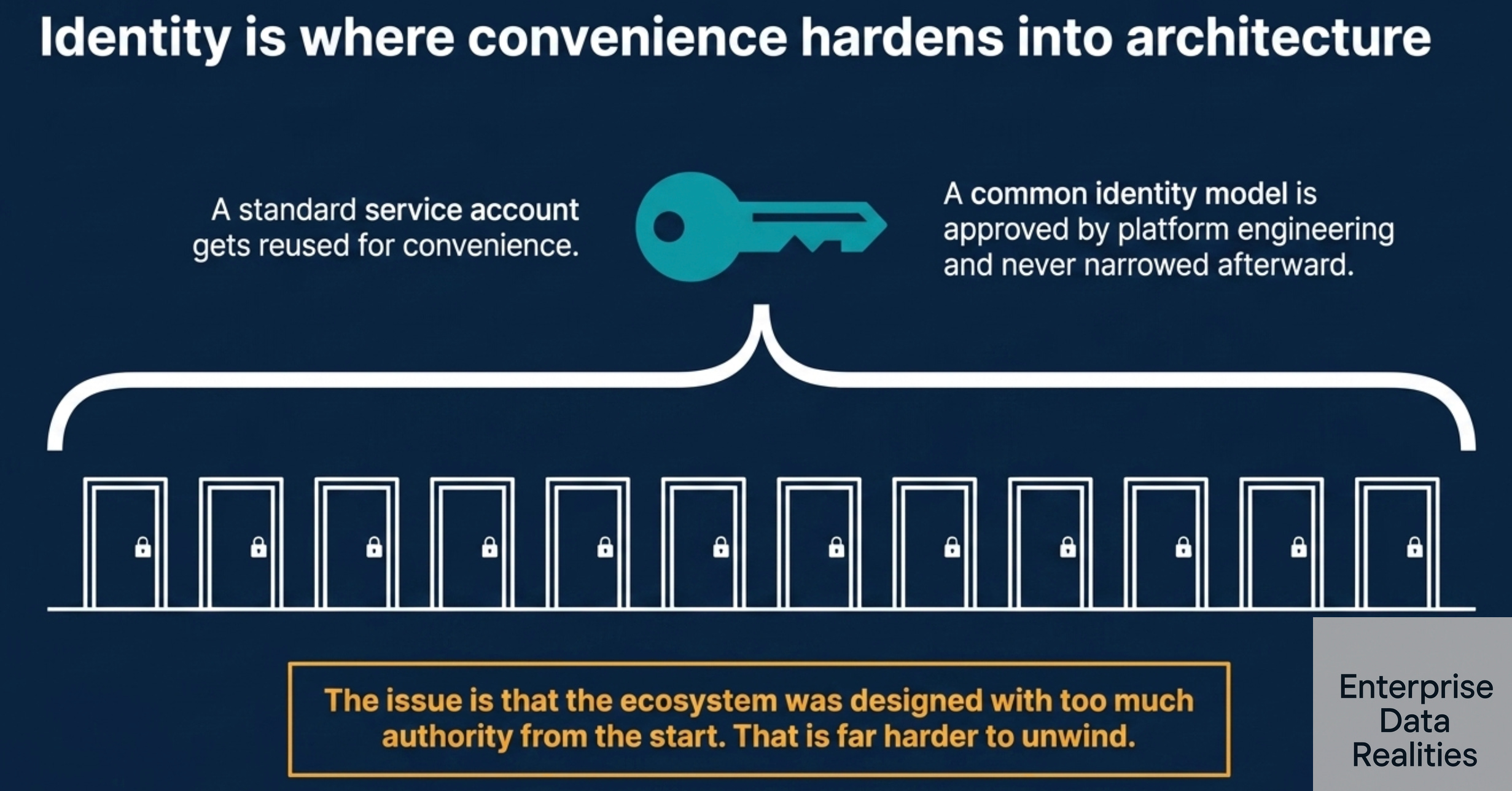
Identity is where convenience hardens into architecture
Single-agent identity problems are easy to recognize. One broad service account. One shared token. At the ecosystem level, identity failures look normal because they feel easier to administer.
A broad access pattern gets copied because it works across teams. A common identity model is approved by platform engineering and never narrowed afterward. This is how convenience hardens into architecture.
Once that happens, the issue is no longer that one agent has too much authority. The issue is that the ecosystem was designed with too much authority from the start. That is far harder to unwind.
Approval paths do not scale on good intentions
One of the easiest claims in enterprise AI is: “We have a human in the loop.”
Maybe. But where? For which actions? Under what volume? Under whose ownership?
A single approval step in one workflow is manageable. Approval across an agent ecosystem is different. Business lines want different thresholds. Operations wants speed. Risk wants tighter control. Over time, approvals become inconsistent, overloaded, or symbolic.
Real governance asks two harder questions:
Which actions across the ecosystem should never execute without review?
Which decisions should never lose meaningful human judgment, no matter how efficient the system becomes?
Governance is also about what must remain human
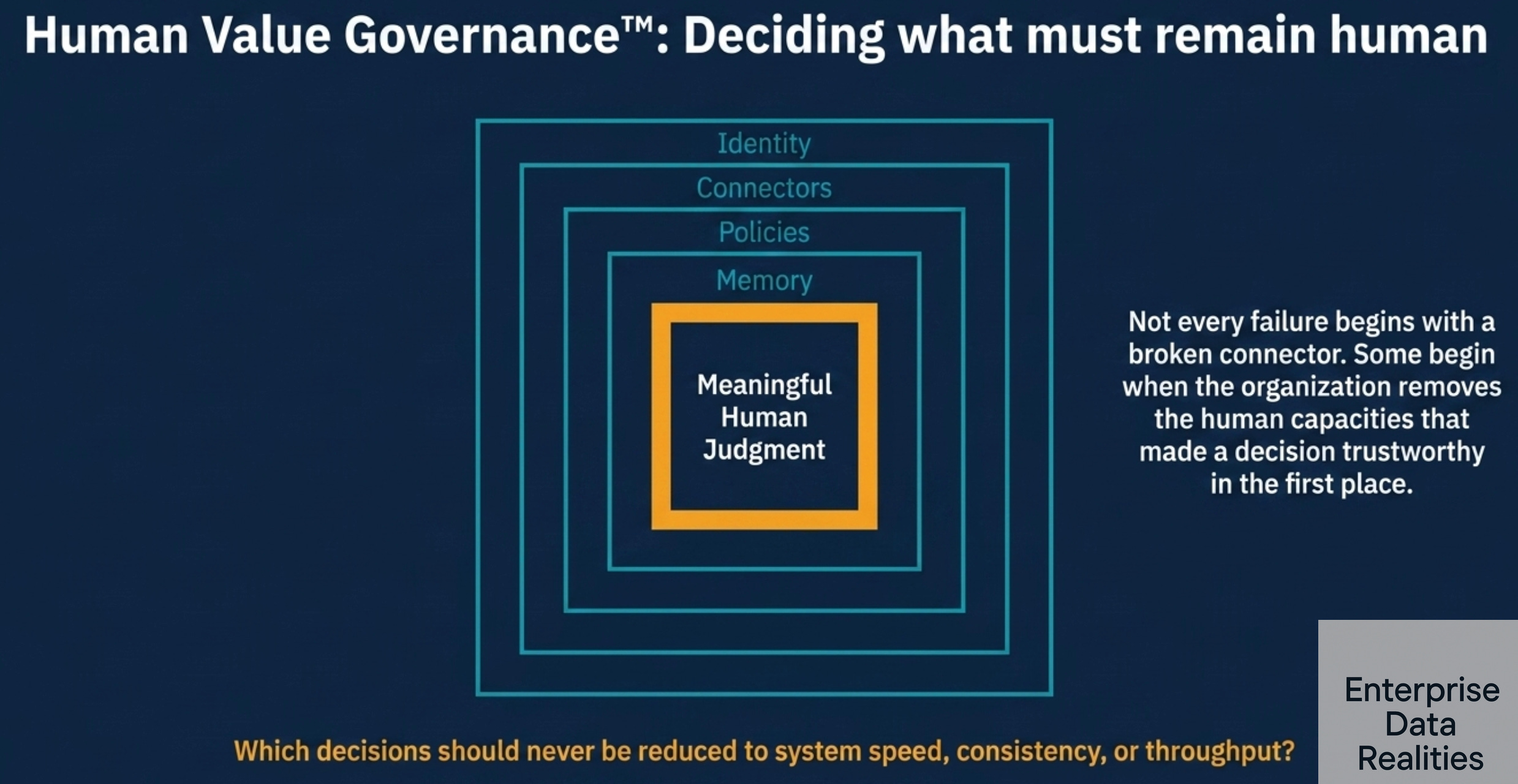
Beyond shared controls, there is a deeper governance question: What human judgment must remain in the loop? That is where the discussion moves beyond controls and into responsibility.
Some failures begin when the organization designs judgment out of the work. This is where Human Value Governance™ adds an important layer. It frames governance around protecting what AI must never replace, grounded in six human qualities and seven organizational covenants.
That matters because an approval path may exist and still remove real judgment. A policy may be enforced and still flatten discretion. A workflow may be efficient and still erode empathy or moral accountability.
Governance is not only about which actions require review. It is also about which decisions should never be reduced to system speed or throughput in the first place. That is the line leadership has to hold.
The real failure is not always that an agent acted badly. Sometimes the failure is that the organization redesigned the work so that human judgment no longer had room to matter.
Inventory is necessary, but it is not governance
Knowing that forty-seven agents exist is not the same as governing them. A list tells you what exists. A map tells you what can fail together. A real ecosystem view should answer:
Which agents share connectors?
Which agents share identities?
Which agents share memory services?
Which agents share approval paths?
Which agents can trigger internal actions?
Which agents can influence customer-facing outcomes?
That is the difference between inventory and governance.
Policy drift: The ecosystem problem most teams miss
Single-agent review assumes the system you approved is the system now running. That assumption rarely survives scale. Connectors change. Defaults change. Roles expand. One team adds a field. Another widens access.
Now the ecosystem is drifting. Not because of a redesign, but because the platform moved underneath the agents. This is why incident reviews become messy. The product team describes the agent they thought they had, while audit examines the platform they actually ran. Those are often not the same system.
The first real question leaders should ask
When teams say they have AI governance, the first question should not be: How many agents do we have?
The first question should be: What do they share?
Shared connectors. Shared identities. Shared policies. Shared memory. Shared defaults. That is where the risk concentrates. If you do not know what is shared, you do not know what can fail together.
What to stop pretending
Stop pretending inventory is governance.
Stop pretending one strong review of one agent protects the broader system.
Stop pretending shared memory becomes safer because it is reused.
Stop pretending approvals scale on intent alone.
Stop pretending one weak default stays local.
Bottom line
An agent ecosystem is not just a collection of agents. It is a shared control surface.
A weak agent is risky. An agent ecosystem with weak governance becomes a distributed control problem. Shared connectors, identities, memory, and policies turn local weakness into enterprise-wide exposure.
And beyond those shared controls sits a harder leadership question: what human judgment must remain protected even when the system is working as designed?
If one bad setting can quietly affect many agents, the problem is no longer the agent. It is the platform. And governance has to meet the platform at that level.
