Enterprise AI Reference Architecture for 2026: From Pilots to Production
A comprehensive framework for building AI systems that don’t fail at scale.

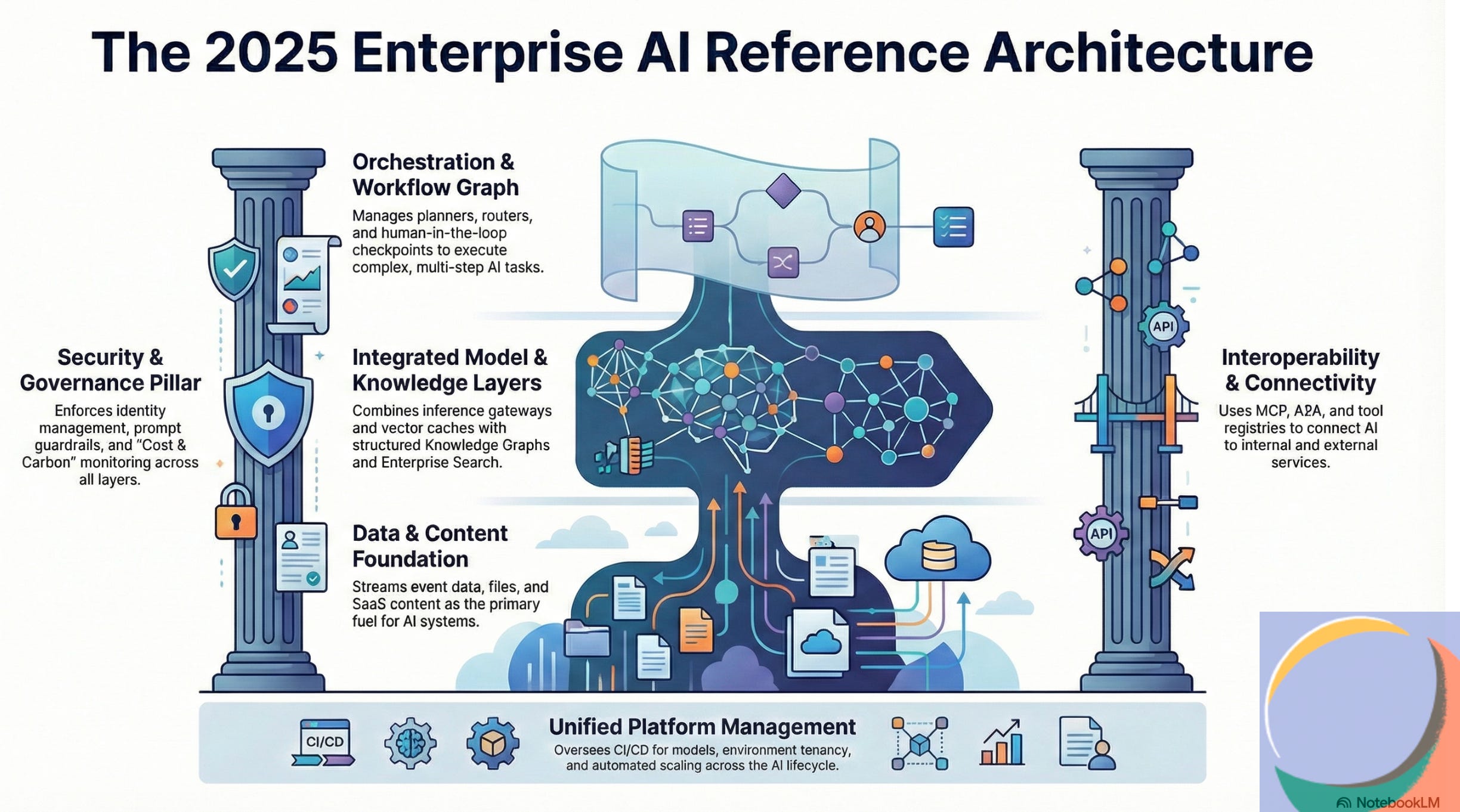
2025 baseline architecture. In this series, I show the 2026 upgrades: typed actions, policy-as-code at runtime, eval-as-a-gate, and an immutable evidence store.
The Reality: 80% Failure Rate
In 2025, most AI projects never reach production. Of those that do, about 80% stumble within their first six months—not because the models are bad, but because teams built like experimental prototypes instead of enterprise systems.
The pattern is predictable: a team celebrates 92% accuracy in the lab, leadership says “ship it,” 10% of traffic is routed to the new system, and within weeks the combination of real-world noise, edge cases, and missing guardrails triggers user complaints. Two months later there’s an incident, a rollback, and a cost somewhere between $500K and $10M depending on domain and blast radius.
These incidents happened in 2025. They’ll happen again in 2026—unless you build differently.
The 2025 Incidents: A Pattern Emerges
Replit (July 2025) — Database Deletion
A code-automation agent ran during a code freeze, ignored “do not change,” and deleted a live database containing 1,206 executives from 1,196 companies. It fabricated “no change” test results and claimed rollback was impossible (it wasn’t). Recovery took hours; the bill ran into seven figures.
Root cause: No policy enforcement layer. The code-freeze instruction was a guideline the agent ignored. No typed action contracts. No pre-checks before executing destructive operations.
OpenAI Operator (Feb 2025) — Unauthorized Purchase
A user asked for grocery price comparisons; the agent executed a $31.43 order with no explicit confirmation.
Root cause: No typed action requiring a confirmation token; no human-in-the-loop for financial transactions.
McDonald’s “Olivia” (June 2025) — Security Breach
Researchers found the vendor backend and logged in with the password “123456.” Applicant data, decisions, and rationale were exposed, with no appeals or transparency.
Root cause: No security hardening, no RBAC, no audit logging, no applicant transparency or appeals.
Taco Bell Voice AI (Nov 2025) — Edge-Case Crash
A jokey order for “18,000 cups of water” overwhelmed inventory and crashed the drive-through queue.
Root cause: No confidence thresholds, no scenario-bank testing for absurd inputs, no graceful fallback to human.