
Enterprise AI: The Operating Model Is the Strategy
Why scaling AI requires bi-directional leadership: top-down clarity and bottom-up capability.

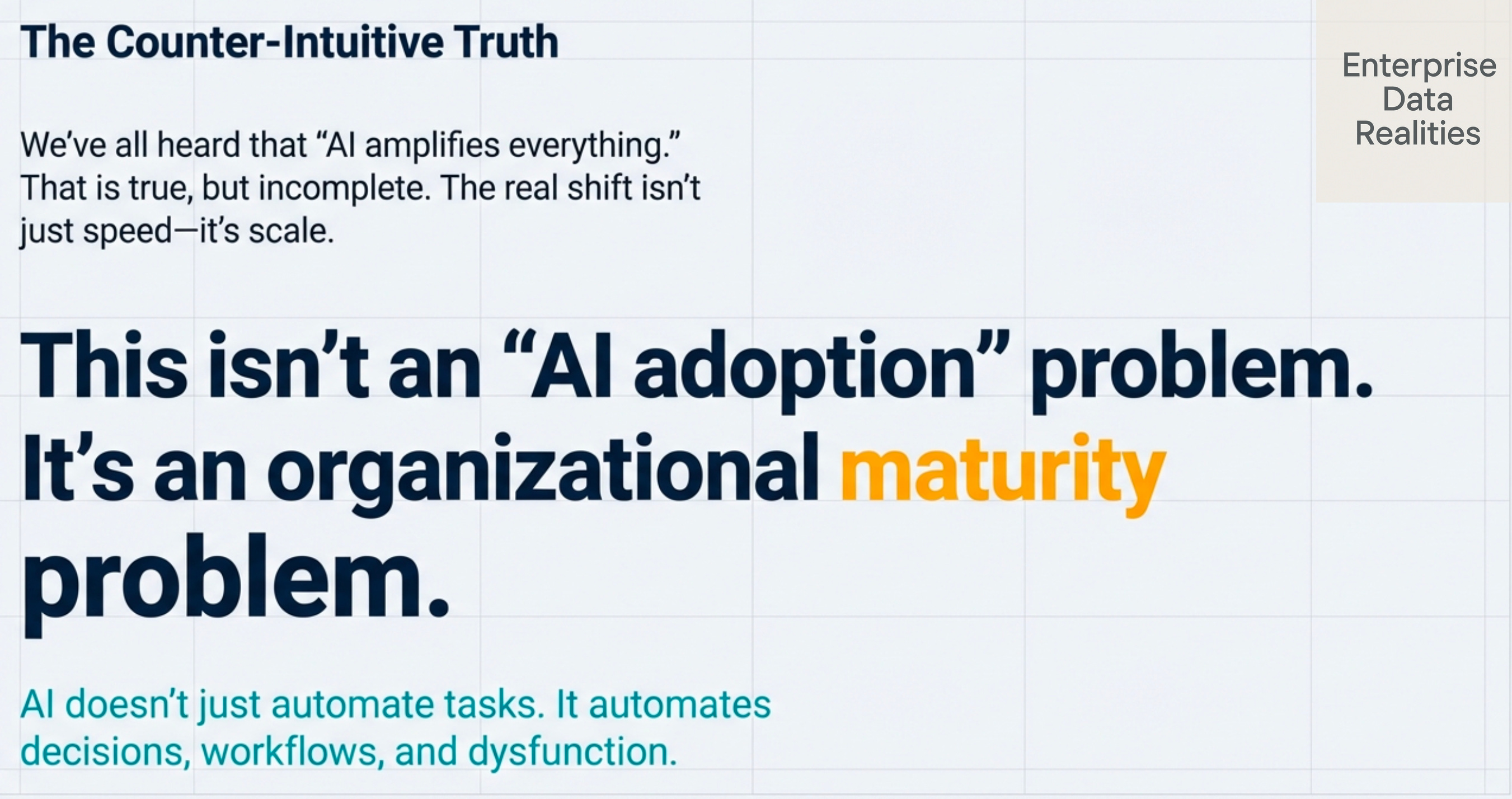
We’ve all heard the line:
“AI amplifies everything — including dysfunction.”
It’s true. But it’s also incomplete.
AI doesn’t just automate tasks.
It automates decisions, workflows, and information flow.
So the real shift isn’t just speed.
It’s scale.
And that’s why this moment feels chaotic in so many enterprises:
Engineers are frustrated because there’s no direction.
Business leaders want broad access to the stack to launch ad hoc (“vibe-coded”) products.
Risk teams see exposure everywhere.
Accountability is blurry.
Morale drops because scrutiny is immediate while clarity is delayed.
This isn’t an “AI adoption” problem.
It’s an organizational maturity problem.
Because AI is not forcing transformation.
AI is removing the ability to hide dysfunction.
In the past, organizations could mask:
unclear ownership
broken processes
fragile data foundations
shadow IT
decision ambiguity
siloed accountability
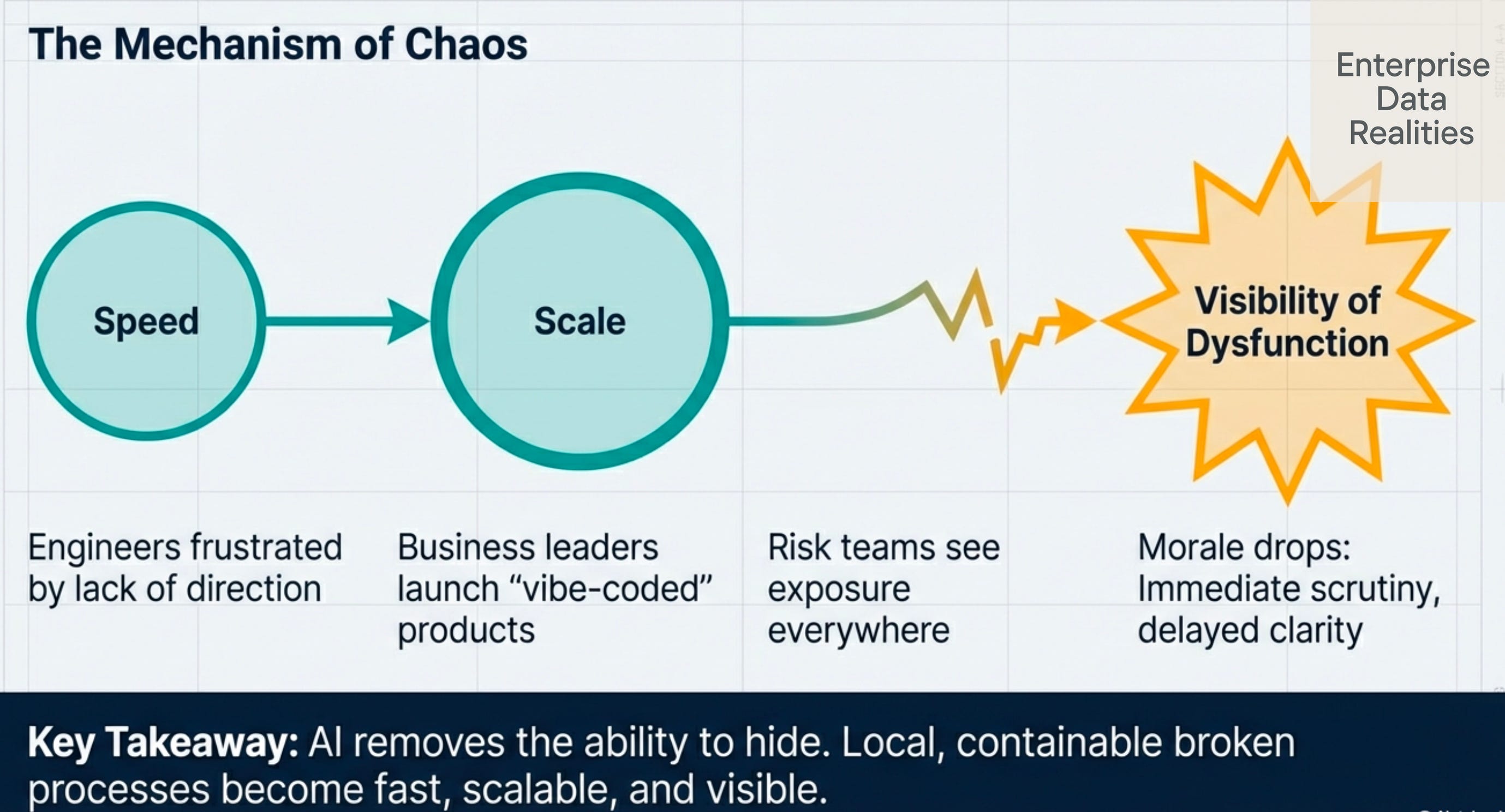
AI amplifies these weaknesses instantly—what used to be local and containable now becomes fast, scalable, and visible.
So the journey isn’t “adopt AI.”
It’s this:
Mature the organization so AI can safely create value.
Why “AI Amplifies Dysfunction” Now Means “AI Scales Decision Influence”
Here’s the more precise governance truth:
AI governance is no longer just governing outcomes.
It’s governing intelligence—what information is allowed to shape decisions, and how that information is interpreted and used.
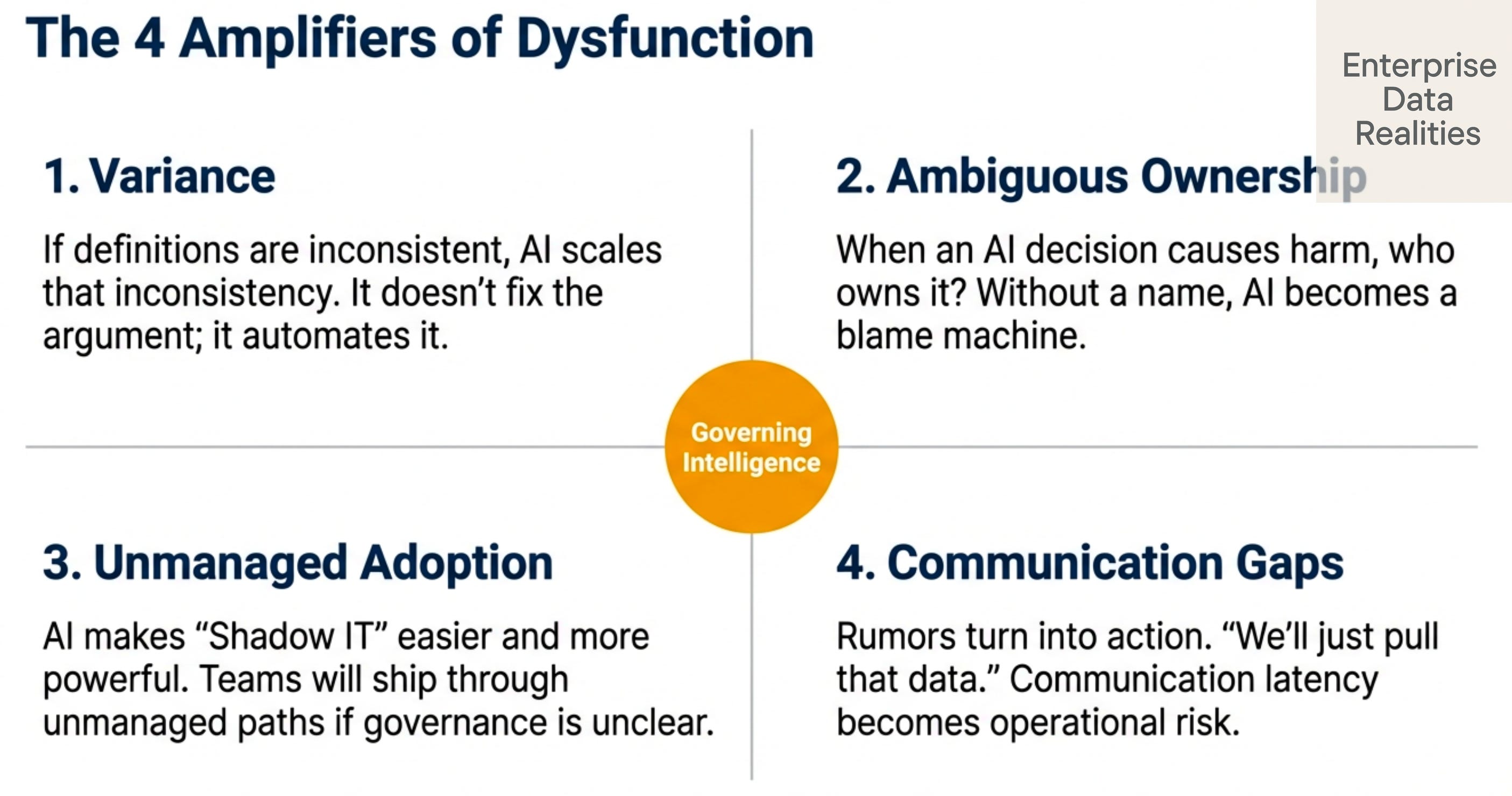
In practice, AI amplifies:
1) Variance
If processes and definitions are inconsistent, AI scales that inconsistency.
If one business unit defines “customer” differently than another, AI won’t fix the argument.
It will confidently automate it.
2) Ambiguous ownership
When an AI-assisted decision causes customer harm or compliance exposure, who owns it?
Product?
Engineering?
Data?
Risk?
Legal?
If you can’t name the owner, AI becomes a blame machine.
3) Unmanaged adoption
When governance is unclear and leaders say “move fast,” teams will still ship—often through unmanaged (“shadow”) paths.
AI doesn’t create shadow IT.
It makes it easier and more powerful.
4) Communication gaps
If leadership takes months to clarify direction, employees fill the vacuum with rumor.
And with AI, rumors turn into action:
“We’ll just use this tool.”
“We’ll just connect it to production.”
“We’ll just pull that data.”
Communication latency is operational risk.
The Journey Requires BOTH Directions
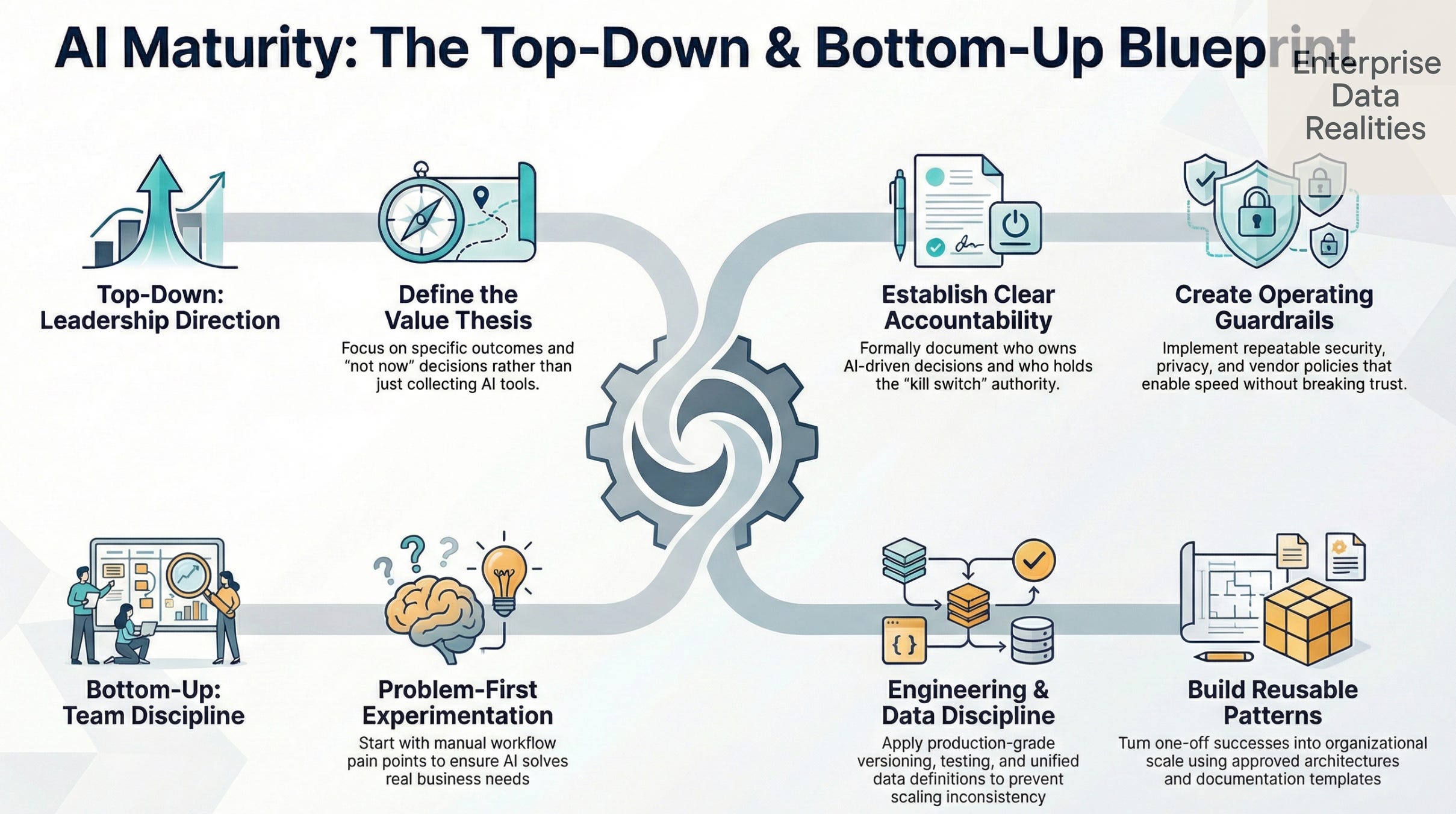
Top-down creates clarity.
Bottom-up creates capability.
Without top-down → chaos.
Without bottom-up → theater.
Innovation happens when both meet.
TOP-DOWN: What Leadership Must Establish
Top-down work isn’t bureaucracy.
It’s the clarity and guardrails that let teams move fast without breaking trust.
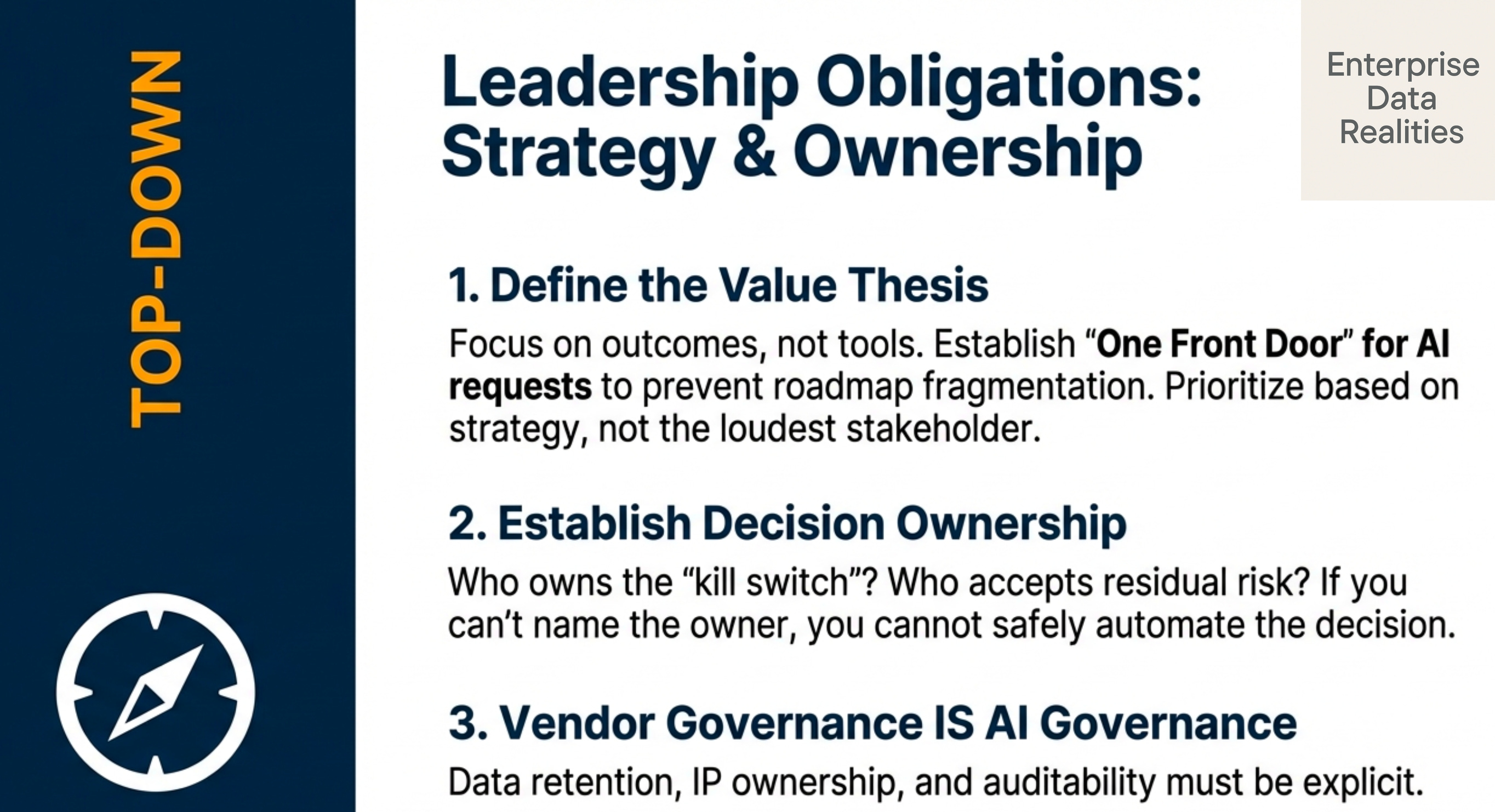
1) Define the value thesis (outcomes, not tools)
Leadership must answer:
What decisions do we need faster or better?
Where will AI create measurable impact?
What problems matter most this year?
To prevent fragmentation, establish a clear demand intake and prioritization mechanism:
one front door for AI requests
prioritization based on strategy, risk, and capacity
explicit “not now” decisions
Without this, the roadmap defaults to the loudest stakeholder.
2) Establish decision ownership and accountability
Who owns AI-driven decisions?
Who owns the override / shutdown authority (“kill switch”)?
Who accepts residual risk, and how is it documented?
This prevents diffusion of responsibility.
3) Create operating guardrails that enable speed
Governance should not be a brake. It should be a repeatable way to move fast safely.
Minimum guardrails include:
security and privacy boundaries
data usage policies
model risk expectations (evaluation, auditability)
evidence, logging, and traceability standards
third-party AI vendor terms (data retention, training use, IP, audit rights)
Vendor governance is AI governance: data retention, IP ownership, and auditability must be explicit, not assumed.
When AI can act (not just advise), guardrails must extend to action governance:
which systems an agent can access
what permissions it can hold
what requires human approval
how impact is contained (“blast radius” limits) through rate limits, spend limits, safe defaults
A simple test:
If a regulator, auditor, or customer asked “why did the system make this recommendation,” could you answer with evidence?
Good guardrails don’t slow delivery. They reduce rework and prevent avoidable incidents.
4) Clarify roles and boundaries
business builds vs engineering builds
experimentation vs production pathways
product vs platform responsibilities
This prevents engineering from becoming the support desk for every prototype.
5) Fund platforms, not isolated tools
AI scales through shared foundations:
governed data access and ownership
reusable services and patterns
governance automation
observability and cost transparency
This prevents tool sprawl and rework.
6) Communicate fast, simple, and often
This is the “people” lever leaders underestimate.
When direction is unclear, engineers live in an anxiety loop:
“Is my role safe?” “Which bets actually matter?” “Will what I build ever ship?”
Leaders must clearly communicate:
what’s changing (and what is not)
what AI means for teams in the next 6–12 months (practical, not hype)
what’s expected this quarter
what is explicitly out of scope
Because the organization will move either way—aligned or not.
And remember: value requires adoption.
If workflows don’t change, AI becomes a feature demo instead of a productivity engine. Adoption requires redesigned SOPs, training and enablement, and incentives that reward using the new way of working.
Where Strategy Works in Practice (What I’ve Seen)
Across large organizations, strategy succeeds when it reduces confusion—not when it increases documentation.
The patterns are consistent:
Leaders set a small number of non-negotiables (value thesis, decision rights, risk posture).
Teams get freedom inside those boundaries to experiment and deliver.
Governance becomes a product (fast, repeatable, automated), not a committee.
When that happens, the organization stops arguing about tools and starts compounding value through reuse.
That’s the moment top-down clarity meets bottom-up capability.
BOTTOM-UP: What Teams Must Build
Bottom-up work is disciplined execution—turning AI from demos into durable capability.
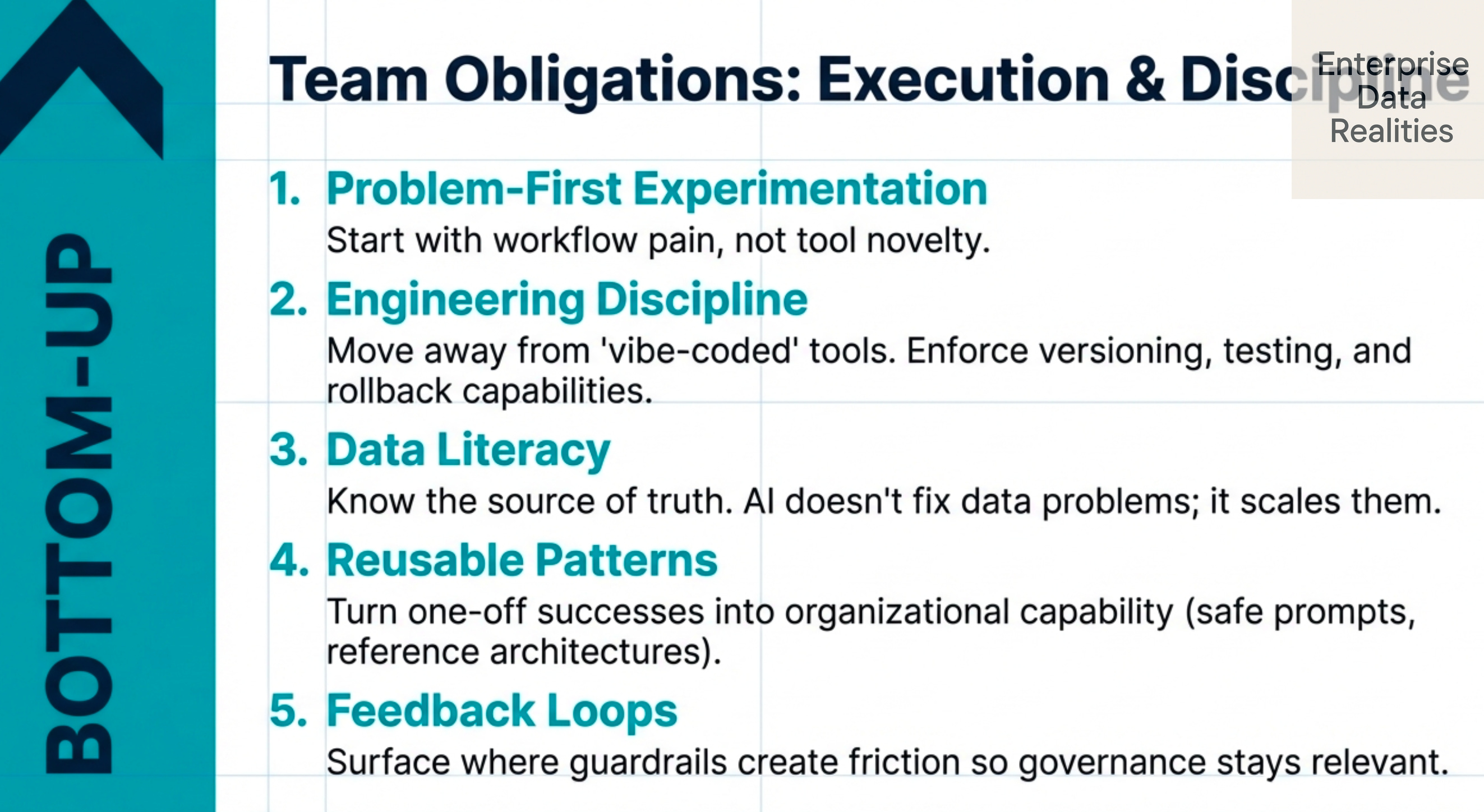
1) Problem-first experimentation
Start with workflow pain → measure improvement → iterate.
This ensures relevance instead of novelty.
2) Engineering and delivery discipline
AI systems must earn production trust:
versioning and testing
evaluation and monitoring
security and access controls
rollback and incident response
performance and cost awareness
This prevents fragile ad hoc (“vibe-coded”) tools from becoming enterprise risk.
3) Data literacy and ownership
AI doesn’t fix data problems. It scales them.
Teams must know:
source of truth
metric definitions and assumptions
quality expectations
who owns the dataset and the business meaning
This prevents automating inconsistency at scale.
4) Reusable patterns and playbooks
Scale comes from reuse:
safe prompt and evaluation patterns
approved integration methods
reference architectures
documentation templates
This turns “one-off success” into organizational capability.
5) Feedback loops to leadership
Governance must evolve with reality. Teams should surface:
where guardrails create unnecessary friction
where policies are unclear
what patterns actually work
what should become the paved road
This keeps governance enabling—not blocking.
A Simple Mental Model
Top-Down = Direction + Guardrails + Cadence
Bottom-Up = Execution + Discipline + Learning
Innovation emerges in the middle.
What Organizations Must FIX Now (Not Mask)
unclear decision rights
fragmented data ownership
lack of engineering lifecycle discipline
unmanaged tools and undocumented workflows (“shadow IT”)
governance that slows instead of enabling
communication latency killing morale
leaders chasing tools instead of outcomes
These were survivable before.
They are dangerous at AI speed.
Closing Thought
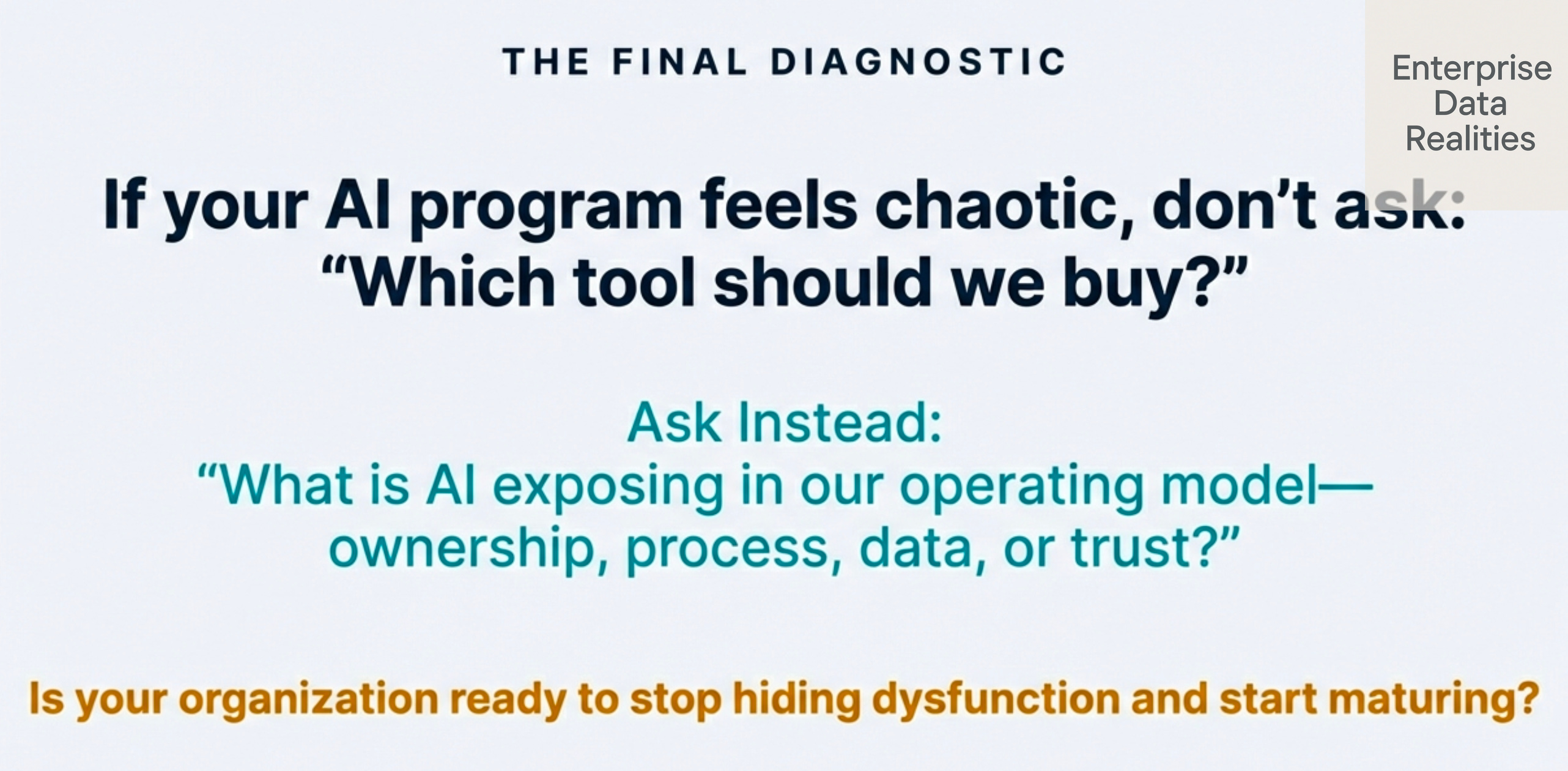
If your AI program feels chaotic, don’t ask:
“Which tool should we buy?”
Ask:
What is AI exposing in our operating model—ownership, process, data, or trust?
And a final test:
If regulators, auditors, or customers asked, “Why did you make this decision?” could you explain it end-to-end?
Because AI isn’t transforming your organization.
It’s stress-testing it.
Question for enterprise leaders
What is AI exposing most in your org right now?
unclear ownership
messy data definitions
process bloat
unmanaged AI usage (“shadow AI”)
fear and low trust
“everyone builds their own thing”
Note for subscribers
If this was useful, feel free to share it with a teammate or leader who’s navigating enterprise AI right now. And if you’d like more frameworks like this (plus deeper examples and practical templates), upgrading helps me keep the series going.