
When Agents Meet the State
From Office Assistants to National Infrastructure

The Anthropic–Pentagon Standoff (and the “Portability” Wake-Up Call)
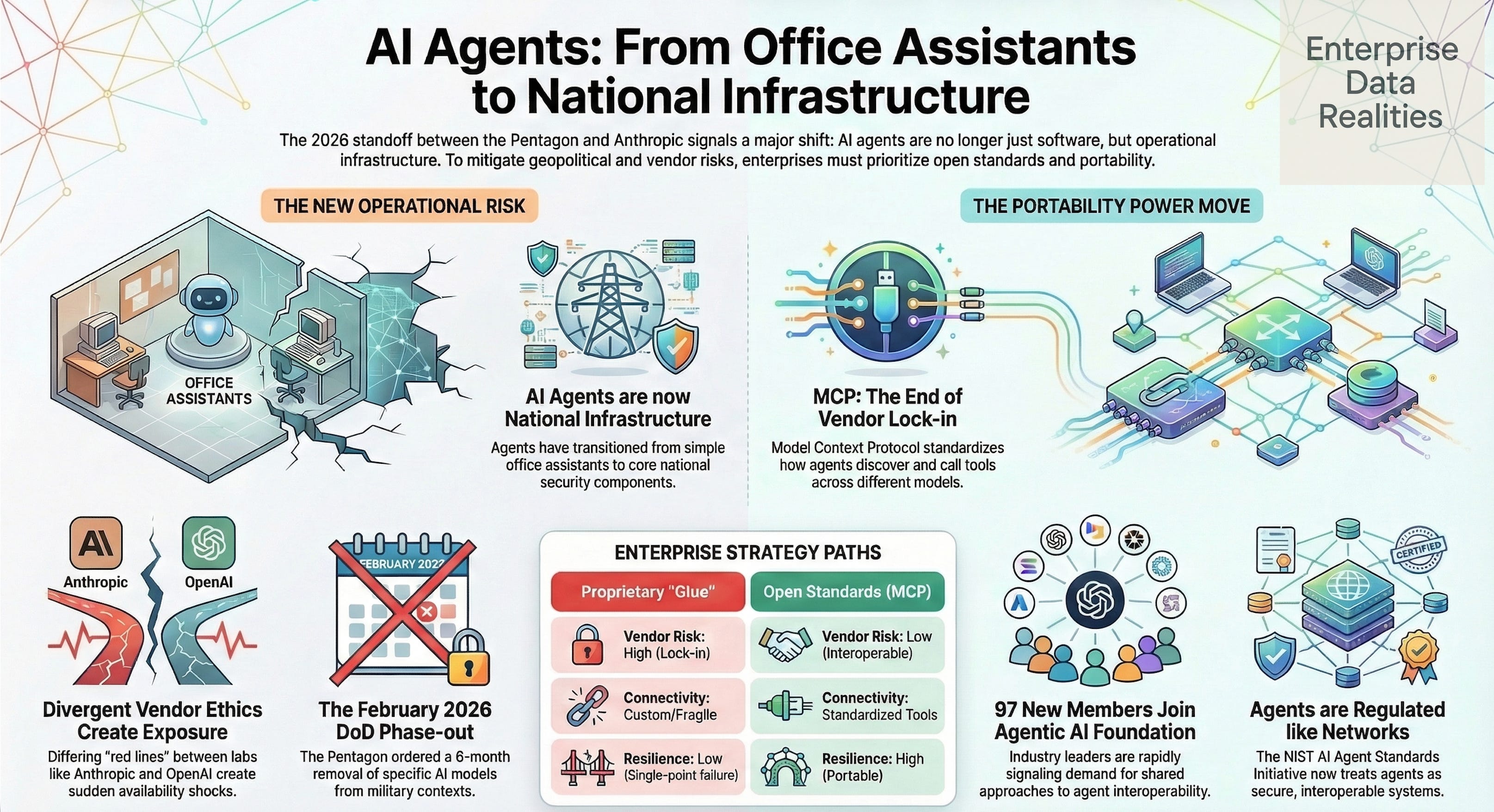
Agents evolved from office assistants to national security infrastructure in six months. In the past week, the U.S. government tested those limits and enterprises are next.
The Incident: When Governance Hits Geopolitics
In late February 2026, the Pentagon escalated its dispute with Anthropic over access and usage limits for their Claude AI in military contexts. Anthropic, holding firm on its ethical red lines, refused the broader access. This prompted a swift Trump administration order for a six-month phase-out across the Department of Defense and federal contractors, with defense giants like Lockheed Martin moving quickly to comply.
Around the same time, OpenAI rushed a Pentagon deal. However, facing immediate backlash, they amended it just days later, adding critical anti-surveillance safeguards.T
his incident cuts both ways:
Anthropic’s ethics held firm: This created a sudden, non-technical availability shock for its DoD users.
OpenAI adapted, then amended: This highlighted intense scrutiny and the need for rapid policy adjustments.
Either path creates enterprise exposure: ethics-based restrictions, intense procurement scrutiny, or sudden availability shocks. This wasnt a normal vendor outage. It was geopolitics colliding with the agent stack overnight.
What This Means for Enterprises
If agents touch your approvals, customer workflows, finance operations, or supply chains, your AI vendor is no longer “just software.”
Your vendor is now operational infrastructure.That means your vendors ethics, their political exposure, or new government procurement rules can now become a direct availability risk for your business. This is precisely why standards bodies are moving fast.
NIST launched its AI Agent Standards Initiative in February 2026, explicitly framing agents as systems that must be trusted, secure, and interoperable across the ecosystem. Translation: agents are no longer demos. They’re starting to be governed like critical networks.
Portability Is the New Power Move (Why MCP Matters)
Most agents today run on proprietary glue: custom connectors, one-off tool calls, and fragile workflows.
That glue becomes lock-in.
Open standards like MCP (Model Context Protocol) aim to reduce that lock-in by standardizing how agents discover and call tools across different models. This means you arent tied to one vendor’s specific way of doing things.
The “standardization” layer is gaining real momentum. The Agentic AI Foundation (AAIF) announced 97 new members in February 2026, including Anthropic and Microsoft, signaling strong demand for shared approaches to agent interoperability.
Simple example:
If your agent only works through one vendor’s proprietary connectors, switching vendors means rebuilding your entire workflow.
If your tools are connected through an MCP-like standard interface, you can dual-run Vendor A and Vendor B without rewriting everything.
Agent Governance Checklist
Vendor-agnostic basics for production agents:
Agent Identity: Named ID + accountable owner for every agent.
Agent Registry: An inventory of all agents + their access rights.
Runtime Policy: Clear rules (allow / deny / escalate) for agent actions.
Telemetry + Audit Logs: Trace every action and tool call for full transparency.
Rollback / Kill Switch: The ability to safely disable agents and revert changes.
If your agent can take actions, it needs the same controls you’d demand from a human with admin access.
The Pentagon Test
Run this tabletop exercise:
“If our primary agent vendor had a public clash tomorrow, can we switch or dual-run in 30–90 days?”
Check reality:
Dual-model capability: Can you A/B test or run multiple models in production simultaneously?
Portable prompts, tools, and logs: Are your agent workflows easily transferable?
Fallback mode: Do you have human workflows, smaller models, or restricted tools ready as a safety net?
Short Point of View
Don’t try to pick the “right” vendor. Build so no single vendor owns your agents. Critical infrastructure demands standards, controls, and clear exit strategies.
4 Questions to Ask AI Vendors NOW
Dual-run path?
Identity/audit support?
Runtime controls?
Misuse evidence?
Agents execute at scale. Governance decides whether they survive politics.
What’s your portability score? Reply below and let’s discuss.
References
Reuters: Lockheed removes Anthropic post-Trump ban (Mar 4, 2026).
Reuters: Trump administration orders Anthropic phase-out (Mar 4, 2026).
Reuters: OpenAI amends Pentagon deal after backlash (Mar 4, 2026).
NYT: Details of OpenAI surveillance amendments (Mar 3, 2026).
OpenAI: Statement on Department of War agreement (Mar 2, 2026).
NIST: Announcing the AI Agent Standards Initiative (Feb 17, 2026).
The Linux Foundation: AAIF press release: 97 new members (Feb 24, 2026).
Deep Dive: Enterprise Data & AI Realities
For those who want to go deeper into the underlying architecture of this shift, I invite you to follow my further reading.
).